Chapter 1 Cost Management Approaches Of The Japanese
By alternately learning from and then challenging the West, Japan has provided many of the world’s business innovations since the 1970s. In this book we describe four new accounting tools from Japan for cost management and, equally important, we describe the five business practice innovations and four cost engineering tools that make the accounting tools work. Since the cost management practices we describe have their roots in the business culture, this first chapter illustrates some of the important changes in Japanese business since the 1960s. Failure to understand the roots of the new Japanese tools is one of the main reasons these tools often fail in the West.
One of the main problems Westerners have when studying the Japanese is that they study the business techniques without realizing how inextricably tied they are to the culture. In this book we bridge the gap by presenting context as an integral part of the tool. We start by focusing on the changes in Japan’s business environment.
 A Framework for Current Management Accounting in Japan
After having experienced process automation in the 1960s, the Japanese began to move aggressively into factory automation. The impetus came from the declining birth rate and resulting shrinkage in number of available employees. Pushed by the change in demographics, Japanese companies made their major investments in automation based not on financial considerations--but on survival needs. Without automation they could not continue to make products in Japan! As a result, they encountered and broke through the limits of conventional cost management earlier and more forcefully than most Western firms. The changes from traditional to flexible manufacturing systems (FMS) to factory automation (FA) and later to computer-integrated manufacturing (CIM) demanded dramatic improvements to management accounting. The Japanese responded to this challenge by developing unique management accounting tools such as target costing and cost engineering tools such as just-in- time (JIT).
The Japan Accounting Association revealed many of the newest developments in its influential book, Integrated Cost Management (Sakurai et al., 1993). The key concept is that of integrated cost management (ICM), defined as a comprehensive value chain approach to strategic cost management for products, software and services. This includes the entire product life cycle from research and development (R&D) to product planning, design, manufacturing, sales promotion, physical distribution, operation, maintenance and disposal. It is expected that cost reductions and quality improvements, across the life cycle and value chain, will provide the highest overall benefit. That is, the most effective cost management operates at the strategic level. Figure 1 shows the typical philosophy and techniques in the 1960s and 1990s.

In addition to the demographic shift, Japan has few resources and has suffered a series of jarring economic shocks starting with the oil crisis in the early 1970s. Since Japan must import all factors of production except labor, a company’s cost structure depends on the international market prices for commodities--a highly volatile system. As a result, the Japanese are much more aware of the strategic implications of cost management than most Western firms.
Responding to the above factors, Japanese management has gradually divorced itself from predominantly U.S-derived methods to create a distinctively Japanese approach. This change has penetrated so deep as to include the general business approach, organizational structure, major areas of accounting activity and accounting techniques. Although the Japanese approach is unique and part of its own cultural matrix, we can learn many lessons. In the following sections we identify five major innovations in business practice, four new accounting tools, and four cost engineering tools.
General Business Approach or Operating Doctrine
IKM Operating Doctrine
INNOVATION 1. The implicit contract between employee and employer has been changed.
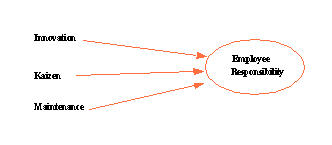
Planning and control systems are indispensable in societies where a command-and-control orientation prevails, such as the United States. However, Japanese firms have redefined the employee obligation to consist of what Sakurai and Scarbrough (1995) call innovation, kaizen, and maintenance (IKM). This framework alters the structure of the job and organization of the company as well as profoundly transforming the implicit labor contract between the organization and the employee. IKM is not a change in technique, but a change in culture.
In this context, innovation means that a basic responsibility of an employee is to develop innovative changes to products or production processes as a result of introducing new technology and/or investing in plant and equipment. It is the result of discontinuous discovery activities and is radical in its effect. Kaizen is the employee’s responsibility for continuously improving current activities. It includes not only daily, small continuous improvement, but also changes in management structure. Maintenance means the employee has responsibility for maintaining current standards in technology, business and operations. The traditional view of employee responsibility would be only “maintenance.”
This change from the traditional “planning and control” perspective to IKM may be the most significant piece of the puzzle for U.S. businesses attempting to use Japanese methods. It is not widely known that IKM attitudes are the necessary driving force behind the Japanese cost engineering tools such as JIT, total productivity maintenance (TPM), total quality control (TQC), and value engineering (VE).
 |
|---|
Uniquely, the IKM approach is explicitly purposive, from the three names (IKM) to the language it uses, while the planning and control approach is not. Our traditional planning and control approach implicitly assumes that the purpose of the organization flows from upper-level managers, and that the tools and their users are somewhat detached professional service providers. None of the many U.S. tools such as standard costing, operating budgets, variable costing, or capital expenditure budgets implies improvement in any business function-only planning and control. In fact, it would be possible to have a perfectly functioning system using those techniques and still have no effective improvements or even attempts at improvements.
The framework of IKM fits Japanese companies in using TQC, JIT TPM and target costing better than the traditional framework of planning and control because IKM tools are also purposive-each seeks not to discipline its subject, but to change its nature. The purpose of TQC is to improve quality. The purpose of JIT is to reduce inventory. The purpose of TPM is to improve machine availability. The purpose of target costing is to reduce product cost. The IKM operating doctrine and the Japanese tools probably developed together, but even if they did not, they are mutually supportive. In fact, many failures of North American companies to succeed with the Japanese cost engineering tools may come from the lack of reinforcement and direction provided by the IKM operating doctrine.
Organizational Structure
INNOVATION 2. Pervasive use of cross-functional work groups.
Cross-functional work groups change the way the Japanese operate. In the past, the structure of the business organization was based on functions such as production, marketing, purchasing, R&D, engineering, personnel and accounting. Even today this functional organization is essential because of the specialized knowledge base each area develops. The functional areas provide the reservoir of expertise needed for success. In addition, however, cross-functional structures have become indispensable for developing new products or conducting R&D because they express strategic imperatives at the operating level. These cross- functional structures are important because they allow the cooperative work of each area to influence other areas, as well as allowing tradeoffs in cost between areas.
In many instances this influence occurs informally. The information density in each functional area, however, has increased dramatically and, at the same time, increased physical and organizational distances make communication more difficult. To ensure that the cross-functional activity takes place, even in the face of obstacles, most Japanese companies create formal work groups with a cross-functional structure that co-exist with the traditional functional structures.
INNOVATION 3 Japanese firms practice job rotation across functional boundaries.
High-profile Japanese firms rotate management employees across functional areas throughout their careers. By the time they are in mid-career, most have had extensive experience in accounting, finance, marketing and production. This experience helps them function very effectively in cross-functional teams. The broader experience that they have gives them an ability to envision the value chain and make tradeoffs that are strategically consistent with the company’s mission. Taken together, the cross-functional work groups and forced job rotation reinforce, and may even have caused, the development of Japanese CIM and the value chain approach.
Major Arenas for Management Accounting
INNOVATION 4. Use of managerial accounting in new functional areas and in different industries.
In the past, management accounting was used mainly in production, marketing and, in some cases, finance functions it is used in many other areas now. Currently, management accounting is used in R&D; product planning and design; and such life-cycle planning areas as operations, maintenance and disposal. Due to many features of Japanese business this has not increased the numbers of accountants, as might be expected in the United States. Instead, managerial accounting has become a responsibility of all managers. In the past, management accounting was used mainly in the manufacturing industries. Currently, it is also used extensively in the computer software, telecommunications, merchandising and other service industries.
INNOVATION 5. Use of ROS as a strategic goal.
In high-technology companies, return on sales (ROS) rather than return on investment (ROl) has been used increasingly for the corporate profit goal. ROS can be used strategically when it is used along with efficient tools for reducing inventory such as JIT or target costing. Increasingly, leading Japanese companies do not typically use ROI.
Individually, any one of these five innovations would be important. Taken together, they have an incalculable effect on Japanese business and strategic effectiveness. As we will see later on, attempting to use specific Japanese techniques without the underlying support offered by these five innovations dramatically reduces the chances of success. In the next section you will see some of the accounting and cost engineering methods that arose from this Japanese business environment.
Major Management Accounting Techniques
In the 1960s and 1970s, Japanese companies used traditional management accounting techniques such as standard costing, operating budgets, variable costing and capital expenditure budgeting in almost the same way as did U.S. companies. This use was the result of an active introduction of U.S. management accounting systems after World War II.
Today, the Japanese have added a set of new tools to the managerial accounting palette. These include:
So far, these new tools have been used most intensively in assembly-oriented industries although they are spreading fast. The following familiar cost engineering tools are usually used at the same time.
1. Total Quality Control (TQC)
3. Total Productivity Maintenance (TPM)
The cost engineering tools are regarded as distinct from, but coherent with, managerial accounting. These last four cost engineering tools are not discussed much in this book, since many business people are familiar with them and the business press carries good descriptions of them.
The cauldron of disruptive changes we call the move to factory automation is where the five business practice innovations, accounting tools and cost engineering tools became a coherent doctrine. We need to know more about the move to FA and CIM before looking in detail at the accounting tools. So in the next chapter we will discuss the impact of FA and CIM on Japanese business management and accounting methods.