Chapter 3 The Change In Cost Management Systems In The Age Of Cim
In the prior chapters we saw how the Japanese business environment has evolved and how the evolution was supported by the five changes in the business culture. Now we will look at the subsequent changes in the cost management systems.
Several new techniques have become important in CIM. The most important is target costing, which, in addition to standard costing, has been used widely by Japanese companies for managing total costs. Two newer arrivals axe activity-based costing (ABC), which is used by major U.S. companies to improve overhead allocations, and direct charge of overhead to product line system (DCOPLS), which Japanese companies believe is more effective for cost reduction. Perhaps the greatest impact of CIM has been on the use of standard costing. Budgeting has also become more important, particularly in reducing costs of marketing, R&D and overhead.
Declining Role of Standard Costing in Cost Control
Standard costing has been one of the most used cost control tools in business for several decades. Now, however, the cost control role of standard costing in advanced manufacturing technology (AMT) has declined dramatically, even as its financial statement preparation role has increased in importance. There are three main reasons for the change:
First, the main purpose of standard costing is to raise each worker’s efficiency on the shop floor. In AMT such tools are not helpful because industrial robots work at the same level of efficiency at all times.
Second, product diversification and short product life cycles have made setting standard costs extremely difficult. Standard costing, as a practical matter, needs an environment where production costs do not fluctuate often, and where the product itself does not change often.
Finally, the role of cost control at the production and assembly stage has been declining, also as a result of product diversification and shortening of the product life cycle. The focus of cost management has shifted from the production and assembly stages to the planning and design stages.
Cost accountants at Japanese companies such as Toyota, Nissan, NEC and Hitachi unanimously reveal that detailed variance analysis, as conducted more than thirty years ago, is no longer carried out in AMT.
The use of standard costing in Japan
 |
||||
Financial Statement Role of Standard Costing Increases
In contrast, the use of standard costing to prepare financial statements or improve cost accounting procedures has actually increased in AMT. Moreover, standard costing still plays an important role in mass-produced, process- oriented industries. For example, Matushita Battery, the biggest producer of electric batteries in Japan, uses standard costing as an indispensable tool for cost control.
 Increase in the Role of Budgeting
The use of budgeting for cost planning and control has increased considerably. Budgeting not only helps control costs but serves a critical function in planning as well. This definition of budgeting broadens its reach to include direct costs, which have traditionally been controlled by standard costing, and to encompass such indirect costs as marketing, R&D, and factory overhead.
At least three factors contributed to the increased use of budgeting:
First, the increase in indirect costs due to FA-indirect labor such as design, maintenance, supervisory services, R&D, and software development--has increased. Budgeting is an effective tool for managing each of these costs.
Second, the importance of cost planning and control has increased at the upstream stages (R&D, planning and design) and final downstream stages (sales promotion, physical distribution). Budgeting is also effective for managing these upstream and downstream costs. That is, cost management has become more strategic.
Last, those managers who face technological innovation in diversified operations or in group management need effective management systems. These systems have become very important for profit planning in Japan.
The use of budgeting in Japan
|
||
Adapted from: Sakurai, Michiharu, and Paul Scarbrough, integrated Cost Management, Productivity Press 1995. Used with permission |
||
In the United States, profit planning is part of budgeting. This is not true in Japan, where only 13 percent of the respondents have this form of budgeting. Generally speaking, only companies with a top-down style of management seem to use this approach.
New Techniques of Cost Management
In addition to the changes in the traditional techniques of standard costing and budgeting, several new tools have arisen from the push to AMT. Primarily to manage direct costs, target costing has been widely used by Japanese companies and it supplements standard costing. Catch- ball budgeting is the most popular type of budgeting in Japanese companies. It separates profit planning from budgeting and then joins them late in the process. For managing indirect costs, activity-based costing (ABC) has been proposed and used in some major U.S. companies. In Japanese companies, however, a different system has also been developed, which can be called direct charge of overhead to product line system (DCOPLS).
Wide Use of Target Costing
Product diversification, life cycle shortening, and widespread use of industrial robots have made “make-to-cost” increasingly important at the planning and design stages. Target costing (TC) is a multidisciplinary tool of cost management to reduce overall costs applied at the planning and design stages with cooperation of the engineering, production, marketing, development and accounting departments. TC is discussed extensively in a separate chapter.
CIM and TC are mutually reinforcing. First, CIM expedites the use of TC because it can reduce costs at the planning and design stages, which is where CIM operates most intensively. Second, the cooperation of the marketing, engineering and production departments, with the accounting department as coordinator, becomes critical for the successful operation of target costing. Since CIM itself demands the cooperation of marketing, engineering, and production, the two techniques tend to reinforce each other.
Budgeting As Catch
Profit planning for short-range business and strategic purposes begins at the executive level, using a top-down approach. It reflects the strategic profit needs of the organization for ensuring survival and growth of the firm and its affiliates. Then departmental budgets are prepared using a bottom-up approach with the profit plan as a target. If there is a gap in target profit between the profit plan and the budget (which there usually is), the process continues until there is no gap or both sides agree that it is not possible to close the gap (which happens occasionally). A company’s prosperity depends on playing this kind of “catch” between top management and managers at the operational level. It is sometimes called “catch-ball” budgeting. This type of budgeting is the main source of kaizen ideas in most companies.
ABC and DCOPLS
The companies with CIM find it crucial in effectively managing overhead costs. This applies across industries since overhead has increased both as a proportion of total cost and in total. The increasing overhead costs include engineering support, maintenance, planning and design, setup, material handling and quality inspection. Unfortunately, current accounting practice does not provide good solutions for managing overhead effectively.
Current Major Japanese Practices of Overhead Allocation.
Most Japanese academies and practitioners believe that they can manage overhead through budgetary control with the help of middle-range business planning. For management and control purposes, Japanese cost accountants have vigorously sought more reasonable allocation bases, especially since the installation of FMS began. For preparing financial statements, of course, a company cannot avoid allocating overhead, even if it involves arbitrary computation.
Activity-Based Costing (ABC).
The original ABC allocates overhead using more sophisticated allocation bases, known as cost drivers, and therefore supplies better information for strategic cost analysis and cost control. This form of ABC was dominant mainly from the 1980s to 1991, and focused principally on accurate overhead allocation.
Direct Charge of Overhead to Product Line System (DCOPLS).
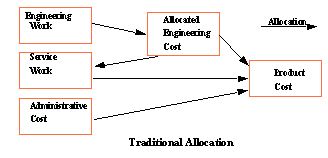
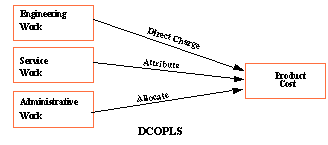
Japanese managers focus more interest on reducing costs rather than on allocating overhead, which does not contribute to cost reduction. To reduce costs, they should be directly charged to a product or products, not be allocated. Quite a few Japanese companies have selected the product line instead of the product as the cost object. They constructed cost accounting systems with few allocations, which are thus useful for cost reduction, but not for accurate product costing. The DCOPLS, with its focus on cost reduction, stands in sharp contrast to the original ABC, with its focus on product cost and its lack of a process view.
However, this does not mean that Japanese managers ignore accurate allocations through activities. In fact, many companies allocate overhead through activity-related multiple rates. Others charge overhead to the product line for reducing costs effectively.
 |
|---|
 |
Cost accounting systems of a software factory
|
||
Adopted from: Sakurai, Michiharu, and Paul Scarbrough, Integrated Cost Management, Productivity press 1995. Used with permission. |
||
Management for Software Development and Information Processing Costs
The amount of computer software used in business increases year by year as the use of computers increases. As a natural consequence, cost management for software has become one of the essential management issues in Japanese companies. We discuss this topic at length in a separate chapter.
We note that cost accounting for software has developed as CIM develops. Generally, at least 40 percent of FA facility costs come from software. If companies install CIM, computer use will increase dramatically and, of course, software use will also increase. Thus, it seems appropriate for companies to install cost accounting systems as automation proceeds.
Cost accounting for software allows software developers to control software development costs effectively. Charge-back systems give effective control over use of hardware and software to evaluate employee or department performance in using information processing services. Companies will have to improve existing systems to cope with the rise in software development costs and information processing costs.
Conclusion
Japanese firms have a strong tendency toward cost management. In several instances-for example DCOPLS-they use techniques that they know to be less-precise measures of product cost in order to direct the behavior of employees toward certain goals. Thus, the cost accounting system binds itself more tightly to the strategic mission and less tightly to concerns about precision in measurement than in the United States.