Chapter 2 Fa, Cim And Their Impact On Business Management
For Management accountants the most important changes in the last few decades have resulted from the rapid movement to more automated and integrated business methods. These new methods wreak havoc on managerial accounting forms of analysis because they violate the unspoken assumptions in the traditional techniques. For example, traditional production accounting methods assume that direct labor drives most costs, yet we know this does not happen in factory automation (FA). The new environment also violates other assumptions, such as the little recognized fact that standard costing is useful for control purposes in situations with low to medium amounts of variability, but not in situations with high variability or the extremely low variability we see in advanced manufacturing technology (AMT).
As a result of such changes, some methods lose their main purpose entirely. One example of this is standard costing, which exists mainly to control direct labor in mass production or medium-variability environments. As we will see later, however, losing the main purpose does not mean that the technique disappears; in AMT even more companies use standard costing than ever-to make it easier to prepare financial statements.
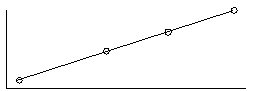
Standard costing and variability
 |
||||
|---|---|---|---|---|
 |
||||
Japanese managers who face advanced manufacturing technology now find themselves searching for new methods of business management more suitable for FA and CIM. They do so from within their experience in the Japanese business culture, which we look at below.
 Background Information on FA
Why did Japan create the massive innovation in FA in the 1980s? No one knows exactly, of course, but here are a few of the factors commonly thought to have been involved:
- Most of the blame should probably go to the labor shortage. Japan reached zero population growth (i.e., total fertility rate was 2.0) in 1975, and shows signs of a devastating decline (i.e., total fertility rate in 1994 was 1.50).Japanese business strategists have been planning for severe and permanent labor shortages since the middle 1970s. In this scenario FA is not a business opportunity, but a much lower-level survival priority. The need to reduce labor use becomes more focused as the shortage expands up the skill ladder to include a scarcity of engineers and skilled workers.
- Increased resistance to hard, dirty and dangerous jobs among young workers. The younger generation wants to work in banks, insurance companies, consulting firms and other similar organizations.
- The rapid fluctuations in the exchange rate (for example, one U.S. dollar brought 360 yen before the 1960s, 260 yen in 1975, 127 yen in 1988, and 80 yen in mid-1995).
- Pressure placed on Japan by the newly industrialized countries in Asia.
Taking these factors together, we can see that they created the conditions of possibility which enabled Japanese managers to justify the investment in what was then such financially risky strategy. In a situation with some similarities, U.S. managers seem to lean more heavily toward off-shore production. We have no hypotheses as to why, although it is obvious that the overall business environment is very different in the two countries.
Then Again, What is FA, Really?
Although we use terms for automation such as FA and CIM as if they were well understood, they are not. So in this section we will define what we mean by these words.
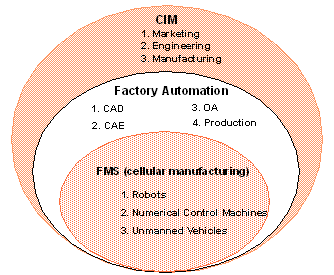
In the United States, the term FMS (flexible manufacturing systems) describes the automation of factories, and more recently we see the term CIM (computer- integrated manufacturing) used. In Japan, however, the term FA has been widely adopted as the all-inclusive term describing the automation of factories. It refers to a coherent automation of a factory that extends to the entire factory and includes such things as technology design, the flow of materials, and the central computer systems, as well as the flexibility to cope with the production of a variety of products in medium and small volume, as distinguished from process automation.
Although FA can have many variations, in this book it means the integration of flexible manufacturing systems (FMS), which integrates industrial robots, numerical control (NC) machines, and unmanned vehicles (using the concepts of cellular manufacturing), with computer-aided design (CAD), computer-aided manufacturing (CAIVI), computer-aided engineering (CAE), and office automation (OA) of the factory. Building on top of this, CIM expands FA to integrate manufacturing, engineering and marketing through computer networks. Figure 4 shows a diagram of FA relationship.
 |
|---|
Flexible Manufacturing Systems
FMS provides the heart of FA. It combines two components: automation of movement (traditional automation) and automation of setups (Numerically Controlled [NC] machines).
Transfer machines and specialized machinery systems increase productivity of mass-produced products, but they lack flexibility. Numerically Controlled machines can change over quite rapidly to a different item (rapid setups) in high- variety/low-volume production. But they have difficulty achieving high volumes.
The combination of the two results in FMS. Since flexibility has become more necessary, various peripheral devices such as automatic conveyors and automatic warehouses are arranged around NC machine tools and industrial robots--all managed by a computer-controlled central system. This arrangement tends to give greater overall productivity and flexibility in the production process.
Computer-Aided Design, Manufacturing and Engineering
Automation of a factory does not stop at automation of the production system. The complexity of many high- technology products has made the engineering drawings much more complex, as well as increasing the number of drawings needed. Hence, CAD has become necessary to increase precision, quality and speed of design.
Office Automation
OA is a system designed to increase efficiency of office work in two respects: (1) reducing the labor devoted to clerical tasks, and (2) supporting creative operations. Productivity in office work had hitherto been backward in comparison with manufacturing productivity in major Japanese companies. Through automation of office work, the paperless factory has become a realistic goal. As a result of standardization efforts, the preparation of document related to production, management accounting operations, communications and storage operations has become more efficient. At the same time, in order to provide support for creative tasks, computer and communications systems provide communication methods such as teleconferencing, electronic mail, electronic commerce, electronic data interchange, and means for accessing the most pertinent information, as well as modes for analysis and processing.
Here we do not mean OA in the narrow sense of introducing personal computers or word processors. Rather it means the broader chain of activities that increase the productivity of white-collar tasks and increase the productivity of such overall operations in the factory as managing delivery times, quality control and control of costs. It contains some of the concepts and activities now popularized under the banner of business process reengineering.
The Emergence of CIM
In the 1 990s, the diversification of the market and the need for individualized products has become more intense. To compete, the business strategy dictated both greater variety and more new products. This is only possible with very tight linkages between marketing, design, production, and the customer. For example, point of sale (POS) technology expands the marketing link to include the customer. Conceptually, this links market information promptly to the development and manufacture of new products-the value chain integration we reported on in Integrated Cost Management (1993).
Such links are, of course, extraordinarily expensive using traditional methods. CIM, however, is a cost-effective means to obtain the tight cross-functional links demanded by the business strategy. Even though CIM is the lowest-cost tactic that can achieve the business strategy, most managers do not usually view it as a cost- reduction method. Awareness that the communication links are a strategic need is not crystallized enough that it leads to analysis of communication alternatives.
CIM should not be thought of as strategy, but as a low-cost tactic to achieve the strategy of value chain integration. The low-level goal of true CIM installations is to integrate all components of the enterprise into a single, unified system. But CIM must also have the higher goal of improving profitability through value chain integration. The political process surrounding a CIM installation can easily make the CIM system itself appear to be the goal.
Japanese companies have not typically gone all the way to true CIM. However, a survey (FA Report, 1994) revealed that the highest goal was the integration of management with manufacturing and technology (33 percent) followed by the integration of marketing with manufacturing and technology (24 percent), and the integration of technology with manufacturing (24 percent).
Although typical Japanese companies strive to integrate marketing into engineering and production, they sometimes end up integrating management into engineering and production. For example, in NSK, the largest manufacturer of bearings in Japan, a division in Fukushima strove to integrate marketing into engineering and production. The division now produces 10 million bearings monthly with only 350 employees, of which only seven are support staff not directly related to shop-floor production. There is only one cost accountant in the division. What made this thorough rationalization possible was that the overall management was linked and consolidated by a computer network.
Benefits Gained by Introducing CIM
Superior competitiveness in a new market comes from cost, flexibility, quality and service. CIM has an effect on all four of these areas:
A company needs to maintain low costs in order to establish a competitive price. Direct labor was reduced through FA, but indirect costs increased greatly. Furthermore, the potential for explosive increases in cost exists when tightening the linkages between functional areas, particularly if using traditional methods. CIM strives not only to reduce direct labor costs, but also to reduce overhead and materials cost through use of innovative software linkages.
Although quantitative evaluation of flexibility is difficult, increasing flexibility makes it possible to respond more quickly to market needs and customer desires. Making different products and different amounts at a low cost becomes possible. Products also can be developed rapidly and a company can fit production to the needs of the market.
Quality means maintaining high standards and increasing the reliability of a product. Claims and returns due to product defects will decrease, and the reliability of products will substantially increase due to improvement in quality from installing CIM.
Service, as used here, refers specifically to shortening delivery times and to improving customer service. Focusing on delivery times maintains the rate at which products are delivered--from the time an order for a product is received, developed and designed to the time it is shipped--in order to improve the quality of service to customers. By reducing delivery times, the lead time (the time from when materials are ordered to the time a product emerges) is significantly shortened.
The Impact of CIM on Business Management
The conversion to FA and CIM has five main effects on companies:
- Coherent, Integrated System for Management A coherent, integrated linkage of the company’s marketing, engineering and production becomes reasonably possible. Because this linkage reduces the cost of design, testing, and production, companies can design new products more quickly and efficiently.
- Organization In the CIM environment, a company responds to the changing needs of customers and must can-y out flexible production. Marketing must drive manufacturing, and not the other way around. An organization that has adopted a participatory style (Koenig, 1990). Such as a network system, is more adaptive. A typical example of Japanese organization is the Syukan (product manager) in Nissan, which is the organization devised for target costing. The Syukan is responsible for a product from its product planning to marketing.
- Reduction of Indirect Labor The introduction of industrial robots eliminates direct labor. Employees directly involved in production are replaced by monitoring, maintenance, R&D, and software development personnel. With CIM, the focus is on reducing planning, design and paperwork. Hence we expect a relative reduction in personnel involved in indirect tasks, the number of which was increased by FA.
- Scientific Methods of Analysis Traditionally, companies had to rely on unscientific methods such as making estimates only on the basis of past experience. As a result of superiority in communication resulting from CIM, management style has become more scientific, and more precise decision-making is possible than in the past.
- Increased Impact of Computer Software Computers, of course, are used more with CIM, so it is no surprise that the use of software increases. The cost of software is so enormous that it will exceed the cost of tangible assets in the next decade. In fact, for a few very advanced firms today, more than 50 percent of the cost of sales would be allocated software cost-if the accounting standards permitted such allocation. Thus, accounting and cost management for software or information technology will be increasingly important to management, perhaps even becoming the most important single cost component in the near future.
These changes have led to large alterations in the cost-management systems commonly used. In the next chapter we present the basic changes.