Chapter 4 Target Costing For Strategic Cost Management
Target costing is the most important new Japanese cost management tool. It is used as the main tool of innovation in the IKM management doctrine. As we described earlier, most management efforts in Japan focus on the three themes of innovation, kaizen (continuous improvement) and maintenance. Overlaid on this management focus, the framework for cost management uses the following: target costing for innovation, kaizen costing for kaizen and cost maintenance for maintaining cost at historical levels.
 |
|---|
Adapted from: Sakurai, Michiharu, and Paul Scarbrough, Integrated Cost Management, Productivity Press 1995. Used with permission. |
Target costing comprehensively manages cost by focusing on a total life cycle cost reduction through innovation in design and production. To reduce costs it integrates production and marketing functions, with engineering as the core discipline. Independently, the CIM environment integrates the production, technology and marketing functions with a communications network to improve their interaction. Since CIM and target costing both involve a similar integration, most companies use them together. Using target cost in conjunction with a CIM environment enhances communications and thus makes both more powerful. In fact, we can reasonably view CIM as contributing to corporate effectiveness mainly by providing the communications support for target costing.
Kaizen costing involves both cost-reduction activities for each product and cost-reduction activities for each cost. Generally, companies control direct material and direct labor costs through VE and other engineering activities. In contrast, they manage overhead mainly through budgeting and the use of the wisdom and know-how of all employees, using TQC, TPM and other techniques.
Maintaining costs was very important in the past. In the CIM environment, however, its importance has diminished remarkably because industrial robots can produce quality products with low cost. Cost maintenance means setting price and quantity standards for product costs and then ensuring that actual results closely match the standards. For the new product, cost maintenance means attaining target costs set by target costing. In the existing product, standard costing plays a role in reaching and stabilizing operations at the standard cost. Cost maintenance activities consist of cost-control activities undertaken to control departmental costs, productivity unit price and equipment.
Definition and Purpose of Target Costing
Although no universally recognized definition for target costing exists, generically it has three main components:
- A target cost is set for a product based on the company’s strategic policy.
- Design-to-cost responsibility is then assigned to cross-functional teams with extremely broad authority. This authority includes, of course, product features, and can also extend to all upstream and dowi1stream support activities and their method of delivery.
- Cost-reduction activity continues until the target cost is achieved or all parties realize it is not possible.
It is important to keep in mind, however, that the technique itself is not as important as the manner of its use. In Japan, this system resides in the network of relationships created by the seven business innovations described earlier. That is, the target costing technique is implemented by people with several important characteristics:
1. They work better in groups.
2. They have a more complete perspective of the value chain due to job rotations.
3. They are personally committed to innovation, kaizen and maintenance.
On the market side, the spread of target costing in Japan is driven by the shortening of product life cycles and intensification of international competition. If products have to be designed and redesigned more frequently, then cost-reduction efforts must focus on the design process. On the internal side, the spread of target costing is driven by the move from traditional production to FA and then to CIM. This move has put in place the integrated communication structures between engineering, production and marketing that are needed to support target costing.
The operational push toward target costing is now seen as a tool for strategic cost management. Since the late 1980s target costing has become even more closely connected with business strategy and thus a strategic cost-management tool for attaining the target profit specified by middle-range business planning. For example, Nissan sets target cost based on target profit which, in turn, is based on business strategy and customer needs. Thus, target costing should now be considered a strategic cost management tool for profit planning as well as cost reduction.
With the aid of hindsight, we see that, when used most effectively, the general purposes of target costing are:
Strategic cost reduction--reducing total costs, including manufacturing, marketing, and user’s costs, while maintaining high quality.
Strategic profit planning--formulating strategic profit plans by integrating marketing information with engineering and production factors.
Characteristics of Target Costing
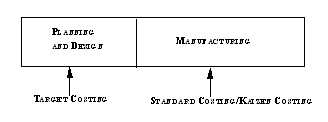
1. Target costing is used in the planning and design stages as shown in Figure 9.
2. Target costing is a tool for cost reduction. Conceptually, cost management can be divided into two parts: cost reduction (or cost planning) and cost control. Target costing is clearly focused on cost reduction.
3. Target costing is a market-driven technique.
4. Target costing is usually part of strategic profit planning for multiple years. In fact, target costing is often used as a bottom-up tool for attaining the profit goal set by top management when it determines middle-range corporate strategy. Thus, the cost-reduction program is more strategic than operational.
5. Target costing is an engineering-oriented technique. Target costing is a management tool for directing and focusing the decision process for design specifications and production engineering. Financial accounting measurements are not emphasized, and the method has more of a management engineering characteristic. Hence, it coincides with other Japanese management engineering techniques such as VE, TQC and JIT.
6. Target costing depends on and enforces extremely high levels of cooperation between departments. In target costing, the accounting department acts as the coordinator and information provider while the marketing, engineering (planning and design) and production departments determine success or failure. It is at this point that we find the convergence of target costing and CIM, which also integrates marketing, engineering and production.
 Target Costing in Manufacturing Companies
Target costing has three main conceptual steps:
New product planning focusing on customer satisfaction
Determining a target cost through company strategic policy and aligning it with achievable costs
Attaining target cost by using VE and other cost-reduction techniques
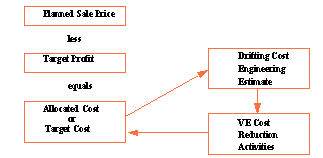
The allowable cost is calculated by subtracting the target profit from the planned sales price. The allowable cost is known as the “maximum permissible manufacturing cost.” It is the desired cost based only on market conditions. The next step is to figure out if the product can be made for this amount. So the “drifting cost” is calculated for each part based on accounting records. This drifting cost is also referred to as an estimated or base cost and is a current estimated cumulative cost, with no target in mind. It is called the drifting cost because it is continuously recalculated as the VE work is performed. The primary work in target costing is, in fact, the VE effort to reduce the drifting cost to equal the allowable cost. The cost reductions come from both the usual discovery of better methods and, most importantly, from trading off costs across functional boundaries (for example, increasing costs in one department to gain cost reductions in another).
The index used in setting the target profit is usually the return on sales (ROS) rather than the return on investment (ROI). One of the reasons for using ROS is the ease of calculating the ROS for each product. But the most important reason is that the use of ROS is strategically superior to ROl as will be discussed in Chapter 6.
The target cost is usually only attained through a painstaking VE program. If the drifting cost does not reach the strived-for goal, then additional cost-reduction activities are carried out with VE programs for second, and third estimates. Finally an attainable target cost is established that can be the goal for production efforts.
After a settling-in period, a report on performance is examined to check whether any cost standards have not been achieved. If any abnormalities have occurred, kaizen costing committees bring out the problems for discussion, and to propose further improvement. Thus, target costing is also a cost-reduction activity based on self-imposed improvement efforts by the factory. An indispensable condition leading to its success is that each employee should participate in the cost-reduction activity. A significant drawback is that it can be too stressful on the employees. A number of companies are reassessing how they manage the target-costing process in order to lessen the adverse impacts on employees. The reasonableness of the target will determine the reactions of the employees.
Method of Setting Target Cost
The target is tied to the strategic policy of the company. In setting the target cost, there are many links with management accounting. The combination method, which is the method presented above as the example of target costing, is a method consolidating the operating focus on profitability and the technological focus on feasibility.
The main approach practiced in Japanese companies is the combination of top-down target cost goals and bottom-up responses presented above. More than half (57 percent) of the Japanese companies we surveyed (106 companies listed on the Tokyo Stock Exchange) used the combination method. The case presented in this book is based on the combination method.
Cost Tables and VE
Companies using target costing find cost tables helpful. The cost table is a tool for estimating such costs as materials, parts, utility, conversion and other costs easily and accurately. There are several kinds of cost tables: one for effectively purchasing parts and material, one for evaluating performance and one for defining rnanufacturing methods and their corresponding costs. There are also both detailed and rough cost tables.
Unlike standard cost cards, cost tables are focused not only on parts or products, but also on activities. They include time and cost estimates for most of the activities that a machine could perform. Having these tables enables engineers to rapidly estimate the cost of alternative designs. In fact, it is akin to having an activity-based data set for potential activities as well as for current activities.
Originally, cost tables were developed and used to estimate the price of purchased parts, but they are now used as a tool for accurately estimating production costs and profit on purchased parts. They are also used as data for showing in-house manufacturing costs. For example, Nippondenso, the top producer of electronic and electrical parts in Japan, uses cost tables as a tool for setting standard costs by estimating such factors as material requirements, conversion processes, plant and equipment, labor hours and conversion cost rate in an orderly method.
Many Japanese companies computerize cost tables to make them more efficient and sophisticated. For example, Nippondenso has 22 types of cost tables in its computer system.
In Japan the cost reduction in target costing is performed by VE. VE is similar to VA (value analysis) used in the United States, but different in several aspects. VE is a method for doing systematic research on each function of a product or service to learn how to attain required functions at the lowest total cost. In other words, it is a method or tool for re-engineering the functions or purposes of a product or service for the purpose of improving the quality or value in order to get customer satisfaction with the lowest cost.
VE can be applied to manufacturing and to service industries. In target costing, VE is one of the keys to effective new product development.
VE proposals consist of both idea proposals and action proposals. Improvement efforts usually focus on manufacturing, but other areas also have room for cost reduction.
For example, the cash savings from VE improvements in one electronics company in fiscal year 1991 revealed that 70 percent came from manufacturing, 12 percent from marketing costs, 9 percent from design, 5 percent form clerical activities, and 4 percent from software and other areas. In Japanese companies, specialists do not have a monopoly on VE. Normally, people conduct the VE analysis concurrently with their normally assigned job. Most companies consider idea proposals an important part of innovation and kaizen, and bonuses are commonly paid as compensation for the proposals.
To make target costing most successful, target costing must be conducted for each product with a matrix organization linking each of the departments: planning, designing, accounting, production, and marketing. For example, Company Z (an automobile manufacturer) introduced target costing several years ago but could not make it work successfully. Later it made several changes to its organizational structure, and made the powerful product manager responsible for target costing. This change strongly emphasized the importance of target costing and rescued the company’s program.
Integration of Middle-range Business Planning into Target Costing
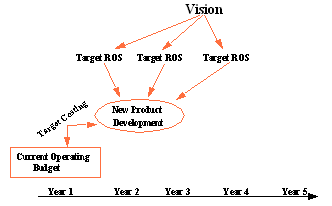
Middle-range business planning, another new device, ties in with CIM and target costing. Companies currently believe they should have middle-range business planning, and that it should closely coordinate with corporate strategy. Japanese managers realized that long-range business planning was unsuitable in a changing business environment because since the oil crisis of 1973, no one has been able to predict successfully very far ahead. Nowadays, typical Japanese companies use middle-range business planning accompanied by a long-range vision. They do not use long-range business planning.
 |
|---|
Middle-range business planning provides the best business venue for new product planning, and target costing provides the essential mechanism for integrating business strategy into these plans.
Some studies report almost 70 percent of the responding Japanese managers integrate middle-range business planning into target costing.
The middle-range business planning horizon typically extends for three years. One of the most important parts is the new product development projects, which are prepared by the engineering or development department. The business planning department, an upper-management staff department, coordinates the project plans, including the new product-development projects, and integrates them into a formal middle-range business plan. The department head of the target costing department usually discusses new products with engineering managers well in advance, so that the target costing manager typically supports the project, which is originally prepared by the engineering department.
Case Study on Target Costing
How is the target cost set? How do companies conduct the analysis for target cost? In order to illustrate the process of determining and analyzing target cost, we will present a target cost example from Company X.
Determination of Target Cost
Company X plans to develop a new automobile, the Crusader. As shown in Figure 11, the product development plan is created by a new product development committee. Management designates a project team and sets a cost target. The team consists of several specialists from different departments such as engineering, marketing, purchasing and accounting.
Target Cost Administration
 |
||
|---|---|---|
Adapted from: Sakurai, Michiharu, and Paul Scarbrough, Integrated Cost Management, Productivity Press 1995. Used with permission |
||
The Product Development Committee decided to produce an automobile that will sell at a planned sales price of 4 million yen. The target profit was determined using the ROS imbedded in corporate strategy of 20 percent. At 20 percent of 4 million yen, the target profit was 800,000 yen. Subtracting the target profit of 800,000 yen from the planned sales price of 4 million yen yielded an allowable cost of 3.2 million yen. The target cost teams were formed and their activities began.
Engineers pulled together the drifting cost based on present technological standards. The drifting cost was 3.5 million yen. This was 300,000 yen more than the allowable cost. VE projects were conducted several times for cost reduction. The results were presented to the first Target Costing Committee, and the plan was studied further to find more room for cost reduction. Target cost was tentatively established as 3.2 million yen.
The cost was reduced by 30,000 yen in upholstery, 2,000 in the drive shaft, 10,000 in the engine, 40,000 in direct conversion costs, and so on. Finally, they were able to reduce costs down to 3.225 million yen. These results were presented to the second Target Costing Committee. They could not eliminate another 25,000 yen of costs to come down to the allowable cost without changing the desired product functions.
The third Target Costing Committee decided that 3.2 million yen would have to be the target cost, and that it would be necessary to focus on cost-control activities during the manufacturing process to eliminate the 25,000 yen variance. This resulted in 3.2 million yen being firmly established as the target cost for the new model automobile. This target cost was considered the standard cost and the company placed its hopes on cost control in the manufacturing stage.
 |
|---|
Adapted from: Sakurai, Michiharu, and Paul Scarbrough, Integrated Cost Management, Productivity Press 1995. Used with permission |
Analysis of Target Cost
All preparation for mass-production was finished and production of the Crusader began. Fortunately, cost reduction activities through VE before manufacturing were satisfactory. That is, cost reductions to 3.2 million yen were made by this stage.
The new product, the Crusader, was very popular. However, an economic downturn caused production volume to fall. Sales volume was originally projected at 20,000 cars; however, only 18,000 cars were sold. Nevertheless, in light of the economy, the Crusader did well.
One month after the beginning of production, actual results were accumulated and variance analysis against the target cost was conducted.
The variance analysis led to two findings: First, because of favorable material and parts costs, total material costs were reduced by 40,000 yen per car. The result of other cost reduction efforts was 10,000 yen per car. Second, because of the decrease in sales volume, fixed cost per unit increased by 60,000 yen per car. As a result, the actual result was over target cost by 10,000 yen per car. That is, actual cost was 3.21 million yen.
At the third Target Costing Committee, a discussion was focused on how to reduce the actual cost to the 3.2 million yen target cost per car. As a result of the discussion, a proposal was submitted to rotate 300 production people to the sales department for a sales promotion. This made sense only because of the experience of the staff in prior job rotations in the firm. Executives and workers of Company X agreed to this project the next month.
Cost Management for Software
Target costing should not be considered a method peculiar to controlling costs of hardware. It also should be seen as a useful method for managing costs of computer software. The main reason for this is the importance of cost reduction in the planning and design stages of software development.
 |
|---|
Adapted from: Sakurai, Michiharu, and Paul Scarbrough, Integrated Cost Management, Productivity Press 1995. Used with permission |
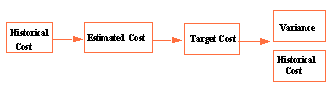
One of the successful software applications of target costing was reported by NEC. Target costing for software is conceptually the same as for hardware but it uses different methods. The structure of target costing in NEC is depicted in Figure 13.
Conclusion
Target costing is a tool for strategic cost management developed originally in Japan and focused primarily on the assembly-oriented industries. It is rapidly spreading to the process-oriented industries, software manufacturers, and other industries. Target costing is a process that is most effective in the high-technology environments of CIM. Nonetheless, this is not to say that there are no problems with this technique. Regardless of how skillfully one introduces target costing, if each and every employee does not actively try to reduce costs, it will have no effect. Also, target costing can easily make unreasonable demands on the workplace.
Target costing works in Japan because the people and administrative structure respond to the needs of the method. Without the business culture of this kind, we are likely to get something that looks like target costing, but which is not very effective. For example, a division of General Motors attempted to use target costing in the late 1980s only to meet total and complete failure when the engineering department withdrew all participation in midprocess. Why? Assigning cost reduction targets to subcomponents is an intense and political process in Japan, which relies on the experience and judgment of mid-level and senior managers, all of whom have similar backgrounds and experience because of job rotations. GM, on the other hand, attempted to use the statistical analysis of a customer survey to assign subtargets. These subtargets were not considered realistic or rational by engineering. In fact, the method assigned the responsibility for the largest cost reduction to the auto frame design group because customer surveys showed that customers did not consider the frame important. When engineering could not convince management of the folly of the assignment, they stopped participating and the project collapsed with a loss of several million dollars.